 Add to Chrome
 Add to Firefox
 Add to Edge
SEAL: Can Saturated Benchmarks Be Revived by LLM-as-a-Meta-Judge?
May 28, 2026
Widely used language-model benchmarks are increasingly saturated, with frontier systems often receiving near-tied scores that standard metrics cannot resolve. Rather than constructing harder alternatives, we ask whether existing tasks can be made informative again through improved evaluation over the same candidate outputs. Therefore, we present Seeded Elimination with Adaptive LLM-as-a-Meta-Judge, a self-improving evaluation protocol for extracting latent ranking signal from saturated benchmarks. SEAL seeds candidate outputs into a single elimination and evaluates each match with task-level principles plus self-improving checklist criteria. We evaluate SEAL on multiple saturated benchmarks covering code generation, mathematical reasoning, knowledge-intensive question answering, and tool-use agent task completion. Across these settings, SEAL improves the ranking-accuracy--latency trade-off over competing protocols, attaining 0.83--1.00 Spearman agreement with full pairwise judging and 4/4 top-1 agreement, while requiring only 11.89 calls per task compared with 28.00 for full pairwise evaluation.

DirectorBench: Diagnosing Long-Form Video Generation with Personalized Multi-Agent Evaluation
May 28, 2026Long-form video generation is rapidly moving from short, single-scene synthesis toward minute-long, multi-shot creation with narrative structure, cinematic control, audio, and cross-modal synchronization. However, evaluating such videos remains challenging, since existing benchmarks largely focus on local visual quality, short-horizon temporal consistency, or generic prompt alignment, and provide limited diagnosis of workflow failures and user-dependent preferences. We introduce DirectorBench, a personalized multi-agent diagnostic benchmark for long-form video generation. DirectorBench evaluates generated videos with respect to 80 structured metadata entries, 7 user profiles, and 40 checkpoint criteria across 5 dimensions: script, visual, audio, cross-modal, and stability. Instead of reducing quality to a single aggregate score, DirectorBench localizes checkpoint-level bottlenecks and supports profile-aware evaluation. We evaluate 4 long-form video generation workflows, 6 base LLMs, and 7 user profiles. Across workflows, DirectorBench reveals a between-unit bottleneck: transition quality averages only 0.256 and reaches 0.356 for the best workflow, while prompt-level user demand fulfillment averages 0.71. We further conduct human evaluation with 14 annotators to validate the alignment between DirectorBench and human judgment. The results show that DirectorBench captures human-perceptible quality differences and reveals workflow- and profile-dependent failure modes that are hidden by aggregate scoring. These findings highlight the importance of diagnostic and profile-aware benchmarking for long-form video generation.
Looking Farther with Confidence: Uncertainty-Guided Future Learning for Sequential Recommendation
May 27, 2026Sequential recommendation effectively models dynamic user interests but continues to face challenges related to data sparsity. While self-supervised learning has alleviated this issue to some extent, most existing methods focus exclusively on immediate next-item prediction during training, thereby neglecting the rich information embedded in longer-term future interactions. Although a few studies have explored the utilization of future data, existing attempts typically apply future supervision signals with uniform intensity across all samples, which may lead to suboptimal solutions. In this paper, we propose an adaptive future learning framework, UFRec, which encourages the model to look further ahead when it is confident in the current state, while focusing on the immediate task when it is uncertain. Specifically, UFRec incorporates an Uncertainty-Guided Future Supervision module that dynamically modulates the weight of multi-step future supervision based on the model's confidence in the primary next-item prediction task. Furthermore, we complement step-wise future supervision with a Future-Aware Contrastive Learning module that treats the future trajectory as a holistic entity. Notably, both auxiliary modules are utilized exclusively during training and incur no inference overhead. Extensive experiments on four benchmark datasets demonstrate that our method significantly outperforms state-of-the-art approaches by effectively leveraging future data.
Distinguishing Right from Wrong in Debates: Attribution Analysis of Chinese Harmful Memes
May 23, 2026Research on harmful meme detection has garnered significant attention, resulting in the development of numerous datasets and methods. However, progress in detecting Chinese harmful memes lags considerably, primarily due to two challenges: first, accurately assessing a meme's harmfulness depends heavily on understanding deep cultural context; second, many memes are semantically ambiguous, making harmfulness highly subjective. To address these issues, we focus on the interpretable detection of Chinese harmful memes by constructing the first Chinese harmful meme explanation dataset, Ex-ToxiCN-MM. This dataset offers opposing interpretations, categorized as "harmful" and "non-harmful", for each meme, aiming to rigorously evaluate a model's ability to discern and comprehend ambiguous, culturally grounded content. We built a specialized knowledge base of Chinese cultural concepts and offensive vocabulary to supply models with essential prior knowledge (C-HarmKB). To address the ambiguity and lack of background knowledge in meme attribution, we have developed a comprehensive attribution analysis framework, RIKE, which includes an Attribution Knowledge Enhancement module (AKE) and a Relative Intent Reasoning module (RIR). Extensive quantitative and qualitative experiments demonstrate that our method outperforms mainstream baseline models across multiple metrics in the task of attributing harmful memes in Chinese. The code, Ex-ToxiCN-MM dataset, and Chinese Harmful Semantic Knowledge Base (C-HarmKB) involved in this study have been open-sourced at https://github.com/wimiw123/Ex-ToxiCN-MM
Retrieve-then-Adapt: Retrieval-Augmented Test-Time Adaptation for Sequential Recommendation
Apr 07, 2026The sequential recommendation (SR) task aims to predict the next item based on users' historical interaction sequences. Typically trained on historical data, SR models often struggle to adapt to real-time preference shifts during inference due to challenges posed by distributional divergence and parameterized constraints. Existing approaches to address this issue include test-time training, test-time augmentation, and retrieval-augmented fine-tuning. However, these methods either introduce significant computational overhead, rely on random augmentation strategies, or require a carefully designed two-stage training paradigm. In this paper, we argue that the key to effective test-time adaptation lies in achieving both effective augmentation and efficient adaptation. To this end, we propose Retrieve-then-Adapt (ReAd), a novel framework that dynamically adapts a deployed SR model to the test distribution through retrieved user preference signals. Specifically, given a trained SR model, ReAd first retrieves collaboratively similar items for a test user from a constructed collaborative memory database. A lightweight retrieval learning module then integrates these items into an informative augmentation embedding that captures both collaborative signals and prediction-refinement cues. Finally, the initial SR prediction is refined via a fusion mechanism that incorporates this embedding. Extensive experiments across five benchmark datasets demonstrate that ReAd consistently outperforms existing SR methods.
From Token to Item: Enhancing Large Language Models for Recommendation via Item-aware Attention Mechanism
Mar 20, 2026Large Language Models (LLMs) have recently gained increasing attention in the field of recommendation. Existing LLM-based methods typically represent items as token sequences, and apply attention layers on these tokens to generate recommendations. However, by inheriting the standard attention mechanism, these methods focus on modeling token-level relations. This token-centric focus overlooks the item as the fundamental unit of recommendation, preventing existing methods from effectively capturing collaborative relations at the item level. In this work, we revisit the role of tokens in LLM-driven recommendation and categorize their relations into two types: (1) intra-item token relations, which present the content semantics of an item, e.g., name, color, and size; and (2) inter-item token relations, which encode collaborative relations across items. Building on these insights, we propose a novel framework with an item-aware attention mechanism (IAM) to enhance LLMs for recommendation. Specifically, IAM devises two complementary attention layers: (1) an intra-item attention layer, which restricts attention to tokens within the same item, modeling item content semantics; and (2) an inter-item attention layer, which attends exclusively to token relations across items, capturing item collaborative relations. Through this stacked design, IAM explicitly emphasizes items as the fundamental units in recommendation, enabling LLMs to effectively exploit item-level collaborative relations. Extensive experiments on several public datasets demonstrate the effectiveness of IAM in enhancing LLMs for personalized recommendation.
FUSAR-GPT : A Spatiotemporal Feature-Embedded and Two-Stage Decoupled Visual Language Model for SAR Imagery
Feb 26, 2026Research on the intelligent interpretation of all-weather, all-time Synthetic Aperture Radar (SAR) is crucial for advancing remote sensing applications. In recent years, although Visual Language Models (VLMs) have demonstrated strong open-world understanding capabilities on RGB images, their performance is severely limited when directly applied to the SAR field due to the complexity of the imaging mechanism, sensitivity to scattering features, and the scarcity of high-quality text corpora. To systematically address this issue, we constructed the inaugural SAR Image-Text-AlphaEarth feature triplet dataset and developed FUSAR-GPT, a VLM specifically for SAR. FUSAR-GPT innovatively introduces a geospatial baseline model as a 'world knowledge' prior and embeds multi-source remote-sensing temporal features into the model's visual backbone via 'spatiotemporal anchors', enabling dynamic compensation for the sparse representation of targets in SAR images. Furthermore, we designed a two-stage SFT strategy to decouple the knowledge injection and task execution of large models. The spatiotemporal feature embedding and the two-stage decoupling paradigm enable FUSAR-GPT to achieve state-of-the-art performance across several typical remote sensing visual-language benchmark tests, significantly outperforming mainstream baseline models by over 12%.
Pedagogically-Inspired Data Synthesis for Language Model Knowledge Distillation
Feb 12, 2026Knowledge distillation from Large Language Models (LLMs) to smaller models has emerged as a critical technique for deploying efficient AI systems. However, current methods for distillation via synthetic data lack pedagogical awareness, treating knowledge transfer as a one-off data synthesis and training task rather than a systematic learning process. In this paper, we propose a novel pedagogically-inspired framework for LLM knowledge distillation that draws from fundamental educational principles. Our approach introduces a three-stage pipeline -- Knowledge Identifier, Organizer, and Adapter (IOA) -- that systematically identifies knowledge deficiencies in student models, organizes knowledge delivery through progressive curricula, and adapts representations to match the cognitive capacity of student models. We integrate Bloom's Mastery Learning Principles and Vygotsky's Zone of Proximal Development to create a dynamic distillation process where student models approach teacher model's performance on prerequisite knowledge before advancing, and new knowledge is introduced with controlled, gradual difficulty increments. Extensive experiments using LLaMA-3.1/3.2 and Qwen2.5 as student models demonstrate that IOA achieves significant improvements over baseline distillation methods, with student models retaining 94.7% of teacher performance on DollyEval while using less than 1/10th of the parameters. Our framework particularly excels in complex reasoning tasks, showing 19.2% improvement on MATH and 22.3% on HumanEval compared with state-of-the-art baselines.
Have We Really Understood Collaborative Information? An Empirical Investigation
Nov 10, 2025Collaborative information serves as the cornerstone of recommender systems which typically focus on capturing it from user-item interactions to deliver personalized services. However, current understanding of this crucial resource remains limited. Specifically, a quantitative definition of collaborative information is missing, its manifestation within user-item interactions remains unclear, and its impact on recommendation performance is largely unknown. To bridge this gap, this work conducts a systematic investigation of collaborative information. We begin by clarifying collaborative information in terms of item co-occurrence patterns, identifying its main characteristics, and presenting a quantitative definition. We then estimate the distribution of collaborative information from several aspects, shedding light on how collaborative information is structured in practice. Furthermore, we evaluate the impact of collaborative information on the performance of various recommendation algorithms. Finally, we highlight challenges in effectively capturing collaborative information and outlook promising directions for future research. By establishing an empirical framework, we uncover many insightful observations that advance our understanding of collaborative information and offer valuable guidelines for developing more effective recommender systems.
Rethinking Contrastive Learning in Session-based Recommendation
Jun 05, 2025
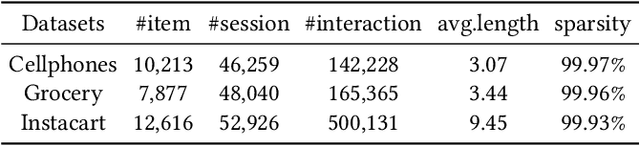
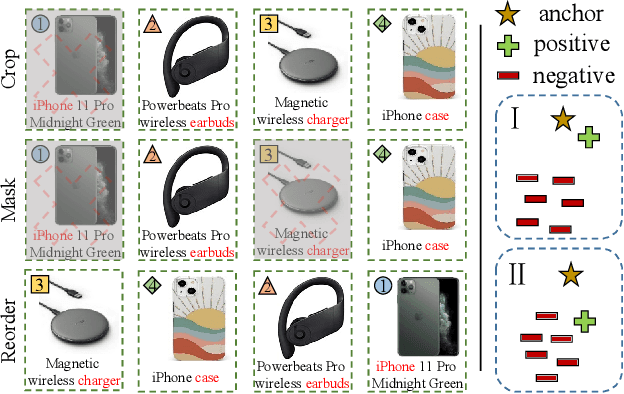
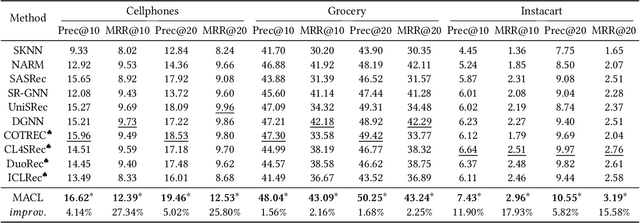
Session-based recommendation aims to predict intents of anonymous users based on limited behaviors. With the ability in alleviating data sparsity, contrastive learning is prevailing in the task. However, we spot that existing contrastive learning based methods still suffer from three obstacles: (1) they overlook item-level sparsity and primarily focus on session-level sparsity; (2) they typically augment sessions using item IDs like crop, mask and reorder, failing to ensure the semantic consistency of augmented views; (3) they treat all positive-negative signals equally, without considering their varying utility. To this end, we propose a novel multi-modal adaptive contrastive learning framework called MACL for session-based recommendation. In MACL, a multi-modal augmentation is devised to generate semantically consistent views at both item and session levels by leveraging item multi-modal features. Besides, we present an adaptive contrastive loss that distinguishes varying contributions of positive-negative signals to improve self-supervised learning. Extensive experiments on three real-world datasets demonstrate the superiority of MACL over state-of-the-art methods.